Sunday, 27 October 2013

Shot List for Preliminary Task


Shot
Location
Shot Description
Framing
Action
Dialogue
Actor
Props
Notes
A
Along the corridor by F11
Jess is walking along a corridor, away from the camera
Long shot
 
 
Jess
 
 
B
Along the corridor by F11
Jess’ feet walking along the corridor to the right
Close up
 
 
Jess
 
Camera needs to be on the right side
C
Outside F11
Jess walks into shot; turns right to face the camera, the camera tracks upwards on to her face.  
Close up
Camera tracks upward from the feet to face.
 
Jess
Ring on finger.
 
D
Outside F11
Freeze on Jess’ face, with her looking nervous, so the title ‘The Exchange’ can appear on screen
Close up
 
 
Jess
 
Shot must be in black and white
E
Door of F11
Jess reaches for the  door handle with her left hand and pulls it down 
 A high angle close up
 
 
Jess
Ring on finger
 
F
In F11
Jess enters thought door  and  the door shuts behind
Mid shot
 
 
Jess
 
The door handle must be down when shot starts
G
In F11
The shot is over the shoulder of a character we are yet to meet, we see Jess walk across the room and sit down on a chair.
Over the shoulder mid shot
 
 
Jess and Mia
 
Shot needs to be taken over the left shoulder

H
In F11
Close up of Mia’s lips, where she asks Jess a question
Extreme close up
 
“Have you got the money?”
Mia
Red lipstick
 
I
In F11
Jess replies and gets out the money, as the camera pans from Mia’s left shoulder to Mia’s right shoulder. 
Over the shoulder Mid shot
Camera pans from left to right
“Yes”
Jess and Mia
50p
Shots needs to start on Mia’s Left shoulder
J
In F11
Jess moves her hand across the table, where Mia’s hand meets it and she takes the money.
Bird’s eye view shot
 
 
Jess and Mia
50p and rings
The ring must be on Jess’ left and hand Mia’s right hand
K
In F11
Mia looks at her hand and reveals the 50p
High angle shot
 
 
Mia
50p and ring
Shot must be taken from over Mia’s right shoulder
L
In F11
Mia throws the bag of skittles across to Jess
Mid shot
 
 
Mia and Jess
Skittles
Shot must be taken on the right
M
In F11
Jess catches the skittles.
Extreme close up
 
 
Jess
Skittles and ring
Jess must catch skittles with left hand
N
In F11
Over Mia’s right shoulder, Jess asks Mia a question
Over the shoulder Mid shot
 
“Same time next week?”
Mia and Jess
 
Shot must be taken from over Mia’s right shoulder
O
In F11
Over Jess’s right shoulder Mia nods
Over the shoulder Mid shot
 
 
Mia and Jess
 
Shot must be taken from over Jess’s right shoulder 

Storyboards for Preliminary Task


We created this storyboard in order to prepare for the filming of the preliminary task. We labelled the type of shots we would use, dialogue that would be said, rough sketches of where actors and props were positioned and any other important details for particular shots. While making the storyboard, we considered what side that we would have to do things from in order to follow the 180 degree rule and match on action. This would keep us on track for filming as we would know what we had do and how we would do it.

No Country for Old Men: Opening Analysis


No Country for Old Men: Opening Analysis

In the opening of the film, many establishing shots are used. These are employed in order to establish the setting for the movie. A narrator is heard while we are seeing these shots, so they also help to explain the setting for the story that the narrator is talking about. The use of the narrator makes the opening more intriguing as the viewer asks questions; what is the relevance of what he is saying? Through the shots, we understand that this environment is very vast and remote, and there are not many people living there at all. The viewer sees nothing of interest happening, so it emphasises the unusualness when something does happen. After the establishing shots, we see the first moving shot, which is a panning shot of the landscape. This tells us that the story is beginning as we have moved away from the still shots.

We then see the first two characters of the film, which are walking towards a police car. This is a generic signifier of thrillers, and indicates trouble because the man in the handcuffs has obviously committed a crime and could be dangerous. We see a close-up of a weapon called a captive bolt pistol. It is a mysterious shot as the audience are unlikely to know what it is, making them ask questions and continue to watch as they want to find out what it is.  The fact that it is a close-up and the weapon is the focal point of the shot
shows that it is an object of significance, and we should
remember it being there.

Once the criminal and the police officer have got into the car, there is an interesting medium close up (and two shot) that can say things about the characters we have been introduced to. The lighting on the police officer is very bright; as if he is in the sunshine- a very positive representation of this character is given, showing that he is a good person. The criminal sitting in the back of the car- and on the left of the screen- is unlike this. He sits in the shadows, with no light on his face. He is also behind bars, symbolising that the danger he causes, as he has to remain separated from the man in the front. As we cannot see this man’s face, he is very mysterious, and the darkness is negative, so he is presented as quite an evil character. This shot therefore juxtaposes two characters just through lighting and props in just a few seconds. As the car begins to drive away, there is another establishing shot- this time of the road ahead of them. It shows the road to quite far into the distance, with no other cars on it.  It establishes that there is no one around to witness what is soon to happen, or what has just happened.
 
When at the police station, there is a shot that shows the officer having a conversation on the phone about what has happened. The criminal sits in the shadows at a distance again, but begins to walk towards the officer- who is closer to the camera. His face is slightly out of shot, so his identity is still obscured. This shot also shows dramatic irony, as the viewer knows that the villain is about to attack a man, who is unaware of this. This is a good way of building tension in thrillers because the victim seems helpless, and the villain has complete power.

When the criminal- Anton Chigurh- starts to strangle the officer, there is a long sequence showing the two of them struggling on the floor. Some of the shots are from floor angle, which is very chaotic as you cannot see exactly what is happening. We also see things from a bird’s-eye-view, and shows Chigurh’s face clearly for the first time, which is very dramatic as it happens when we see him murdering someone. It is also very uncomfortable as the camera seems to gradually closer to his face, and that is the opposite of what the viewer wants. It is also eerie as Chigurh appears to be almost smiling, like he is enjoying killing the man. The sequence ends with a close-up of Chigurh’s face, which is also unnerving because he acts quite calm for someone who has just committed a murder.

He remains relaxed in the next scene when he goes to clean his hands in the sink, as if he has killed many times before. We cut away to the feet of the dead man where we see skid marks along the floor, reminding us of the struggle that just took place. The opening then ends on another close up on the captive bolt pistol, reinforcing the idea that it is a significant prop, and also showing that Chigurh is free to go out and kill more.     

This clip shows most of the opening of the film.
 

Friday, 11 October 2013

Psycho Shower Scene Analysis


Analysis of ‘Psycho’ shower scene, exploring how film techniques are used to create effects

The pace at the beginning of the scene is very slow and drawn out. This is done with the use of shots that last a long length of time, possibly with either a hand-held camera or tracking. We see everything that the female character does, leading the audience to believe that something more must happen soon. It also shows how undisturbed the environment is, which is strongly contrasted a few minutes later when the killer arrives.

This slow pace also gives the audience time to become aware of the victim’s surroundings. We become familiar with the fact that the shower is very loud, meaning that she will not be able to hear the killer approaching, and others are unlikely to hear the murder at all. The fact that she is naked and the lighting is very bright conveys how exposed and defenceless she is. The bathroom is almost completely white, which could connote the innocence of the character, how pure she was and how she didn’t deserve to be killed. The white also emphasises the blood, showing the extent of the damage the murderer has done.

A high angled camera is used a few times, as if she is being looked down on from above. This creates an atmosphere of her being weak and vulnerable in comparison to the superior killer. This follows the convention of the thriller film as she is being portrayed as the stereotypical weak female victim. When the villain enters, the camera pans very slowly across the shower curtain where the viewer can see them slightly. As this is done very slowly it builds tension, as we are waiting for them to pull the curtain away. It could also be said that this is dramatic irony, as we can see that the victim is unaware of the killer’s presence, building tension further.

The scene is edited so that there is a cutaway to a cloudy sky very briefly. This is pathetic fallacy, as the weather has connotations of doom and commotion. It also shows what is happening outside, how the world is unaware of what is happening at the hotel, and perhaps that the loud weather is preventing people from hearing the struggle. The editing during the murder is very fast pace, contrasting to the slow pace before and after, which highlights the chaos of the murder and shows how quickly it occurred. In this section the iconic high-pitched string instrument soundtrack is playing and each of the jabs of the music is the same length the shots. This allows the audience to feel the panic and disorientation of the victim, inspiring sympathy for her. The non-diegetic music turns to a very low bass tone after the murder, which could be said to parallel her heartbeats slowly fading away.
For this shot, the camera has a staggered zoom towards the woman’s mouth. This shows how rough and difficult the whole event is. It is also very uneasy and disorientating, as the audience will not feel comfortable getting close this close to the action. This also highlights that the woman is screaming, giving a fearful and chilling feeling.
This shot is an extreme close up into the plughole of the shower. The plughole is slightly off-centre which could reflect the frenzy and chaos of the whole scene. In this section you can also hear the diegetic sound of the water and blood glugging down the plughole, which can represent her life dwindling away. This is edited so that there is a graphic match between this and the next shot which is an extreme close up of an eye. The pupil of her has got smaller from a previous shot, showing that she is now dead. The graphic means that the shot of the eye and the shot of the plughole share the same idea of her life draining away.
This is another high angle shot which shows the defencelessness and vulnerability of the victim, as we are looking down on her as she is being stabbed. We can also notice how the setting is almost completely white, while there is some red nail varnish on the woman’s fingernails and a red flower pattern on the killer’s clothes. This is done intentionally to have particular connotations: possibly death, blood and anger.   

Sunday, 6 October 2013

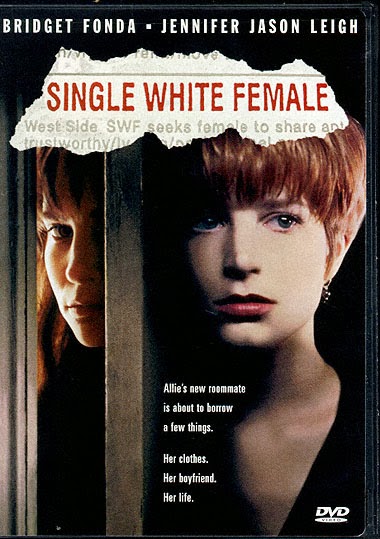
'Single White Female': Mise-en-sene


‘Single White Female’: Mise-en-scene

 
‘Single White Female’ is a thriller movie that was released in the year 1992, starring Bridget Fonda and Jennifer Jason Leigh. The film is about a woman, who has a new lodger to live with her, who soon becomes obsessed with her to the point of imitating her and eventually trying to kill her.

The film is mostly set in an apartment building where the two main characters reside. A lot of the scenes take place in rooms in their apartment, and later in the film’s climax the action takes place in the basement of the building. I think that these locations and sets are an important aspect of the mise-en-scene, because they create a definite claustrophobic atmosphere, as if the protagonist is trapped with the villain and that there is no escape. Especially in the basement scenes when no other characters are aware that they are there, so they cannot be helped.

I think that the main significance of the costumes in ‘Single White Female’ is just to show how Hedra -the lodger- is copying Allie- the protagonist. As Hedra’s obsession with Allie gets worse, she dresses more similarly to Allie. As she starts to look more and more like Allie we get closer to the tensest part of the film towards the end.

Like most thriller films the most significant props are weapons. There are guns used in the film, in the climax Hedra finds a hook and threatens to use it against Allie, and Allie uses a knife to stab Hedra with in the end. Weapons are used to create violent scenes, and the violence is a convention of thriller films to produce danger and therefore build more tension as there is a risk of someone being harmed.